




Blogs
What to Look for in a High-Quality Filter Sponge Manufacturer
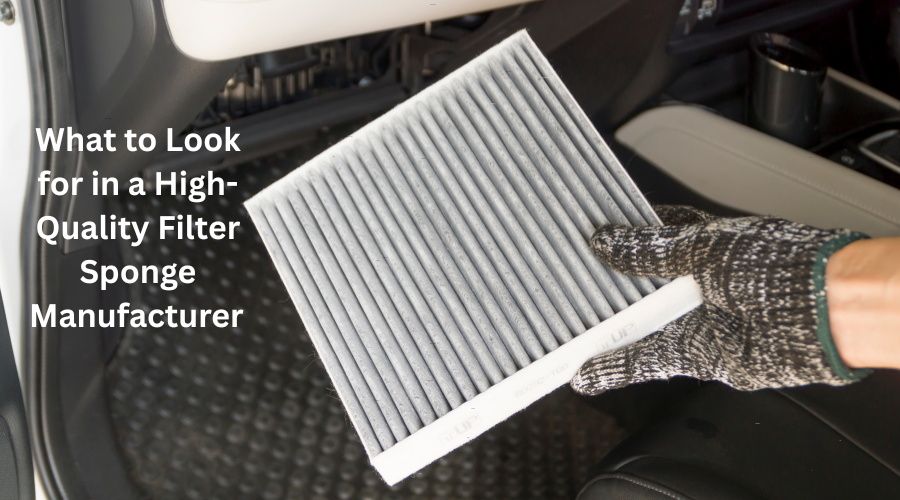
If you manufacture HVAC systems, aquarium filters, or water purification units, you already know that the filter sponge inside your product gets the least maintenance until it fails. When that happens, the consequences and costs rack up quickly. Restricted airflow drives up energy costs for building owners, toxic leachables wipe out expensive aquatic life, and sediment breakthrough forces your wholesale customers to issue costly recalls.
This filter foam is a really simple component but it affects nearly everything about filter performance. It determines the efficiency and replacement lifecycle. Yet many buyers still overlook it, selecting suppliers based on price per unit alone.
This blog changes that approach. Drawing on material science fundamentals and real-world sourcing experience, we will provide a practical framework for evaluating manufacturers of filter sponge. You will understand what questions to ask, which documents to demand when selecting filter manufacturers, all the while cutting through the technical noise to focus on what truly protects your business.
Non-Negotiable Material Science and Formulation Control
Before you even discuss pricing or lead times, you must establish that your potential manufacturer understands the chemistry behind their product. This is where many sourcing relationships go wrong from the start.
Polymer Material
The base polymer material matters immensely for your specific application. If you need filter sponge for HVAC systems, polyether foam resists moisture absorption and hydrolysis, meaning it won't degrade in humid duct environments. For aquarium filters, polyester offers superior wet tensile strength. This helps the sponge maintain its shape during repeated cleaning cycles. However if you are using filter sponge for potable water applications, only food-grade crosslinkers and isocyanates are worthy enough to consider.
Pore Size
Apart from the base material, pore size of the sponge also directly impact performance. Coarse sponges with 10 to 30 pores per inch (PPI) work well for HVAC pre-filters where high airflow matters most. Mid-range options from 30 to 50 PPI fit aquarium biological filtration requirements. The medium-sized pores provide surface area for beneficial bacterial growth while allowing water flow. For the highest purification level, fine sponges above 50 PPI deliver best performance. These are great at sediment removal in drinking water systems.
A competent manufacturer should not only hit your specified PPI target but also demonstrate consistent pore distribution across every batch. But how to confirm if the manufacturer is meeting your requirements? Just ask for their statistical process control data. If they cannot prove it, your final product will suffer from unpredictable pressure drops or channeling.
Industry-Specific Filter Regulatory Compliance The Trust Barrier
The certifications that filter manufacturers display on their labels and billboards are not simply for the sake of advertisement. For consumers, these certifications are the legal shield and market access. Each industry sector has its own regulations and your manufacturer must be able to prove that they are currently in compliance with each one.
Filter sponges used for HVAC applications are required to have UL 94 flame resistance classifications and ASHRAE 52.2 testing for MERV ratings. REACH and RoHS compliance for volatile organic compounds is equally important, especially for indoor air quality applications. If your sponge supplier cannot produce current test reports from accredited laboratories, your finished unit will fail building inspections or LEED certification requirements.
Filter sponges for aquariums are required to comply with even stricter quality standards. This is because aquatic life has zero tolerance for chemical contamination. As a buyer, you need to confirm documented compliance with FDA 21 CFR standards. Well-known manufacturers will provide OECD 203 test results. Without these quality assurances, one failed batch could destroy thousands of dollars worth of livestock and your brand reputation simultaneously
Water filters have to fulfill a different set of certifications. These are NSF/ANSI certifications which are non-negotiable. But you need to be careful: some suppliers claim their products are "tested to NSF standards" but their certification is not considered active. Actively certified manufacturers must maintain current listings with WQA or UL, and they readily provide their listing numbers for independent verification. If your water filter manufacturer lacks a current listing number, retailers will refuse to stock your products, and municipal contracts will remain out of reach.
Quality Process Controls For Filter Sponge Manufacturing
ISO 9001 certification serves as a baseline, but it is not enough to satisfy full requirements. In addition to the basic ISO, another quality certification is ISO 14001 environmental management. And if you plan on using filters sponges in automotive applications, the IATF 16949 automotive-grade quality standard is a must. Automotive-grade translates exceptionally well to general filtration applications as well because it demands statistical process control and zero-defect thinking.
Remember that traceability brings everything together. Every finished product must carry a unique lot code that references raw material batches and specific quality test results. In the event of a product recall, this traceability can save you a lot of legal trouble.
Supply Chain Scalability and Raw Material Traceability
Your chosen manufacturer might produce excellent samples, but can they sustain that quality across massive wholesale orders? If not they are not a reliable partner. Here is how to be sure they are one.
Start by examining their raw material sourcing. Premium manufacturers maintain long-term supply agreements with tier-one chemical suppliers. They provide certificates of analysis for every incoming raw material shipment, ensuring consistent isocyanate and polyol quality. In contrast, a supplier who sources commodity chemicals on the open market will guaranteed face periodic shortages and will get raw materials of variable qualities between batches, leading to an inferior quality filter sponge as the final product.
Another thing you should determine before signing the contract is whether their annual output matches your forecasted demand. You must inquire about how they can scale up from initial pilot orders of five thousand units to full production runs of five hundred thousand units without requiring extended lead times. To ensure that they supply you without any bottlenecks, ask about their inventory buffer strategy. Manufacturers who maintain safety stock of raw materials and finished goods will protect you from shipping delays or sudden demand spikes.
Geographic and logistics factors are factors that affect delivery efficiency. Evaluate whether their proximity to your production facilities makes your supply chain better or introduces unnecessary risk.
Custom Engineering and Technical Partnership
The most valuable manufacturers do not simply fulfill orders—they solve problems. Treat your supplier relationship as a technical partnership rather than a transactional exchange.
A high-quality partner should offer rapid prototyping. 3-5 day turnaround time is sufficient enough if you need custom pore gradients or laminated composites.
When field returns inevitably occur, true partners conduct root-cause investigations using advanced analytical techniques like Fourier-transform infrared microscopy or compression-set analysis. They deliver formal eight-discipline reports that identify the failure mechanism and outline corrective actions. This level of support protects your product liability and continuously improves both parties' quality standards.
In addition to transparency in error detection reports, reputable suppliers will also be honest about disclosing the limitations of the filter sponge they make, like maximum service temperatures, pH operating ranges, and chemical incompatibilities. An honest sponge manufacturer explains these constraints upfront so you design accordingly.
How To Know Sponge Manufacturers is Genuine?
Begin with documentation inspection
First and foremost, request full technical data and safety data sheets from the sponge manufacturer. When confirming certifications, only accept third‑party laboratory reports; do not take a certification PDF at face value. If you feel the manufacturer is making excuses and using delaying tactics, then they are a shady manufacturer, and that is bad news.
Run accelerated tests on samples
Expose all samples to 72 hours of heat‑humidity exposure or ozone chamber testing. This compressed simulation reveals how each sponge performs after years of real‑world service. After that, compare the results against your current supplier's benchmarks. The manufacturer whose sponge maintains its tensile strength, pore structure, and color stability under stress will definitely deliver longer filter life.
Conduct an on‑site factory audit through live video
The best way to conduct the virtual audit is to do it unannounced as a surprise. Do not inform the supplier of filter sponge beforehand. During audit focus on three core areas: laboratory calibration logs, operator training records, and preventive maintenance schedules. When calibration logs are up‑to‑date and training records show continuous education, your manufacturer invests in precision and people.
Criteria for scoring sponge suppliers selection
For the last stage of importance weightages across four quality metrics, material mastery at thirty percent, regulatory proof at thirty percent, quality control data transparency at twenty-five percent and scalability at fifteen percent. Objectively score each manufacturer in these categories to lock in the sponge supplier that works for your business.
Conclusion
The supplier who becomes your partner should fulfill the qualitative aspects rather than just low price. It should be a manufacturer of filter sponge who provides the most accurate data, and demonstrates genuine technical expertise. Choosing that partner transforms your filter sponge from a malfunctioning piece of equipment into a genuine competitive advantage, so make that decision carefully.
Featured Articles
Summary Selecting car sponges in bulk requires all the information we will provide in this blog. It s
READ FULLHighlights The first question to ask when choosing a supplier of car
READ FULLSummary Car owners and automobile washing businesses often face a problem when cleaning cars. That
READ FULL